How to lay turf — a step-by-step guide
Laying turf is a satisfying DIY job that most homeowners can tackle in a day or weekend. Get it right from the start and your new lawn will establish quickly and look great for years to come. This guide covers everything from soil preparation through to aftercare.
Before you start
Tools & materials you’ll need
- ✓Tape measure
- ✓Garden spade or rotary hoe
- ✓Lawn roller or flat board for tamping
- ✓Garden rake for levelling
- ✓Sharp knife or turf cutter for trimming
- ✓Starter fertiliser (available in our showroom)
- ✓Wetting agent (recommended for WA soils)
- ✓Garden hose or irrigation — ready to use
- ✓Wheelbarrow (for moving rolls)
Best time to lay turf
Spring & autumn — ideal
Mild temperatures and good soil moisture help turf establish fast.
Summer
Possible but requires more watering during establishment. Avoid laying on extremely hot days.
Winter
Possible in Southwest WA’s mild climate — growth will be slower but roots will still establish.
Step-by-step laying guide
Prepare your soil
Remove all existing lawn, weeds and debris. Cultivate the soil to a depth of at least 75mm using a spade or rotary hoe. Break up any large clumps and remove rocks and roots. The more time you invest in soil preparation, the better your turf will establish.
Both varieties benefit from well-cultivated soil with good drainage. If your soil is compacted clay, consider adding a soil conditioner or gypsum before laying.
Diagram — soil level vs path level
Level and grade the area
Rake the soil to a smooth, even surface. Grade the area so it falls slightly away from the house or any structures — this promotes drainage and prevents pooling. The finished turf level should sit approximately 20–25mm below any paths, edging or garden borders to allow for the turf thickness.
Apply starter fertiliser & wetting agent
Spread a quality starter fertiliser evenly across the prepared soil and rake it in lightly. Apply a wetting agent at this stage too — this is especially important in Southwest WA where hydrophobic sandy soils are common. Both products are available from our Bunbury Showroom.
Diagram — brickwork laying pattern
Lay turf in a brickwork pattern
Start laying from a straight edge — a fence line, wall or path is ideal. Lay each roll end-to-end, then offset the next row by half a roll length, just like a brickwork pattern. This staggers the joins and gives a more natural look once established. Butt joins tightly together — gaps will dry out and die.
Never stretch the rolls to fill a gap — always cut to fit. Stretched turf will shrink back as it dries and leave visible gaps.
Ensure firm soil contact
After laying each section, press the turf firmly into the soil using a lawn roller or by walking a flat board across the surface. Good soil-to-root contact is critical — air pockets underneath the turf will cause the roots to dry out and the turf to die. Pay extra attention to joins and edges.
Trim edges neatly
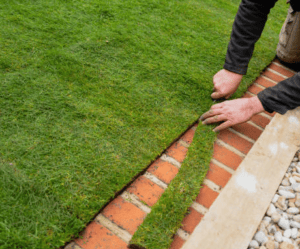
Use a sharp knife or turf cutter to trim around garden beds, paths, edging and obstacles. Cut from the top down — pressing firmly through the turf and into the soil. A clean, straight edge makes a big visual difference and prevents the turf from lifting or separating at the borders.
Water immediately and thoroughly
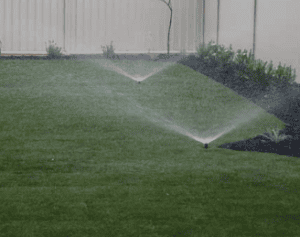
Water your new lawn deeply and immediately after laying — don’t wait. The turf should be moist all the way through to the soil beneath. For the first two to three weeks, water daily to keep the soil moist. Reduce frequency gradually as the roots establish and the turf begins to knit into the soil.
Watering schedule
35-day establishment schedule · 1 April – 30 September
** Exemption required via Water Corporation **
| Days | Water depth | Frequency | Timing |
|---|---|---|---|
| Days 1–14 | 4.0 mm | Twice daily | Before 9am and at 2pm |
| Days 15–28 | 7.5 mm | Once daily | Before 9am |
| Days 29–35 | 7.5 mm | Every second day | Before 9am |
42-day establishment schedule · 1 October – 31 March
** Exemption required via Water Corporation **
| Days | Water depth | Frequency | Timing |
|---|---|---|---|
| Days 1–10 | 5.0 mm | 3× daily | Before 9am, 12 noon, 3pm |
| Days 11–20 | 5.0 mm | Twice daily | Before 9am and 3pm |
| Days 21–28 | 10.0 mm | Once daily | Before 9am |
| Days 29–42 | 20.0 mm | Every second day | Before 9am |
These schedules are a guide for establishment under an exemption. Adjust for the weather — water more in hot, dry or windy conditions and less after rain. Always confirm current Water Corporation rosters and exemption conditions for your area before you begin.
Aftercare — the first 6 weeks
Watering
Follow the watering schedule above.
Traffic
Avoid foot traffic for the first 2–3 weeks while roots knit into the soil.
First mow
Mow when growth reaches 50–60mm — usually 3–4 weeks after laying. Set blade high for first cut.
Fertilising
Apply a lawn fertiliser 4–6 weeks after laying to support ongoing growth and colour.
Products to help with laying
Ready to get started?
Order your turf online or get a free quote — and remember, we’re always here if you need advice.